

Mesh Flattening Machine
Mesh Flattening Machine
Quantity:
Mesh Flattening Machine
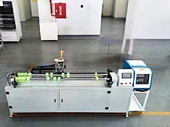
wire-mesh-flattening-machine is specialized equipment designed to flatten or smooth out wire mesh that may be uneven, crumpled, or have irregularities due to manufacturing, transportation, or storage. This process improves the mesh’s flatness, precision, and usability for various applications. Below is a detailed overview of its functions, working principle, components, and applications.
Wire mesh roll is loaded onto the unwind stand → tension is applied to straighten the mesh.
Mesh enters the flattening rollers → pressure from upper/lower rollers smooths out waves or bends.
Guiding plates ensure the mesh remains centered during processing.
Optional brushing unit cleans the mesh surface.
Flattened mesh is wound into a roll or cut into sheets → ready for further fabrication (e.g., welding, punching, or assembly).
Mesh enters the flattening rollers → pressure from upper/lower rollers smooths out waves or bends.
Guiding plates ensure the mesh remains centered during processing.
Optional brushing unit cleans the mesh surface.
Flattened mesh is wound into a roll or cut into sheets → ready for further fabrication (e.g., welding, punching, or assembly).
Component | Role |
Unwind Stand | Holds the wire mesh roll and controls unwinding speed. |
Flattening Rollers | Upper and lower rollers that apply pressure to flatten the mesh. |
Roller Adjustment System | Mechanism (e.g., handwheel or motorized) to change roller spacing. |
Tensioning Units | Maintain consistent mesh tension during feeding and flattening. |
Guiding Rails/Plates | Keep the mesh aligned and prevent misalignment. |
Cutting Device | Cuts the flattened mesh into specified lengths (optional). |
Drive System | Motors and gears that power the rollers (e.g., 3–5 kW motors). |
| Mesh thickness | 0.3~1mm |
| Max.mesh width | ≦1200mm |
| Speed of shaft | 8circles/min |
| Motor power | 7.5kw |
| Power supply | 380v/50hz |
| M/C weight | 3000kg |
| M/C size | 2300×1400×1400mm(L×W×H) |
Maintenance Tips
Regularly clean rollers to remove debris or metal shavings.
Lubricate moving parts (e.g., roller bearings, adjustment mechanisms) to prevent wear.
Check roller alignment and tensioning systems for accuracy.
Regularly clean rollers to remove debris or metal shavings.
Lubricate moving parts (e.g., roller bearings, adjustment mechanisms) to prevent wear.
Check roller alignment and tensioning systems for accuracy.